Skin conditions
Psoriasis Assessment and Coordination of Care
Psoriasis is a chronic immune-mediated inflammatory condition. It commonly appears as well-defined thickened plaques with scale, but its appearance and distribution vary widely between people.
Assessment covers the skin, the scalp and nails, joint symptoms and general health, because psoriasis is more than a surface condition.
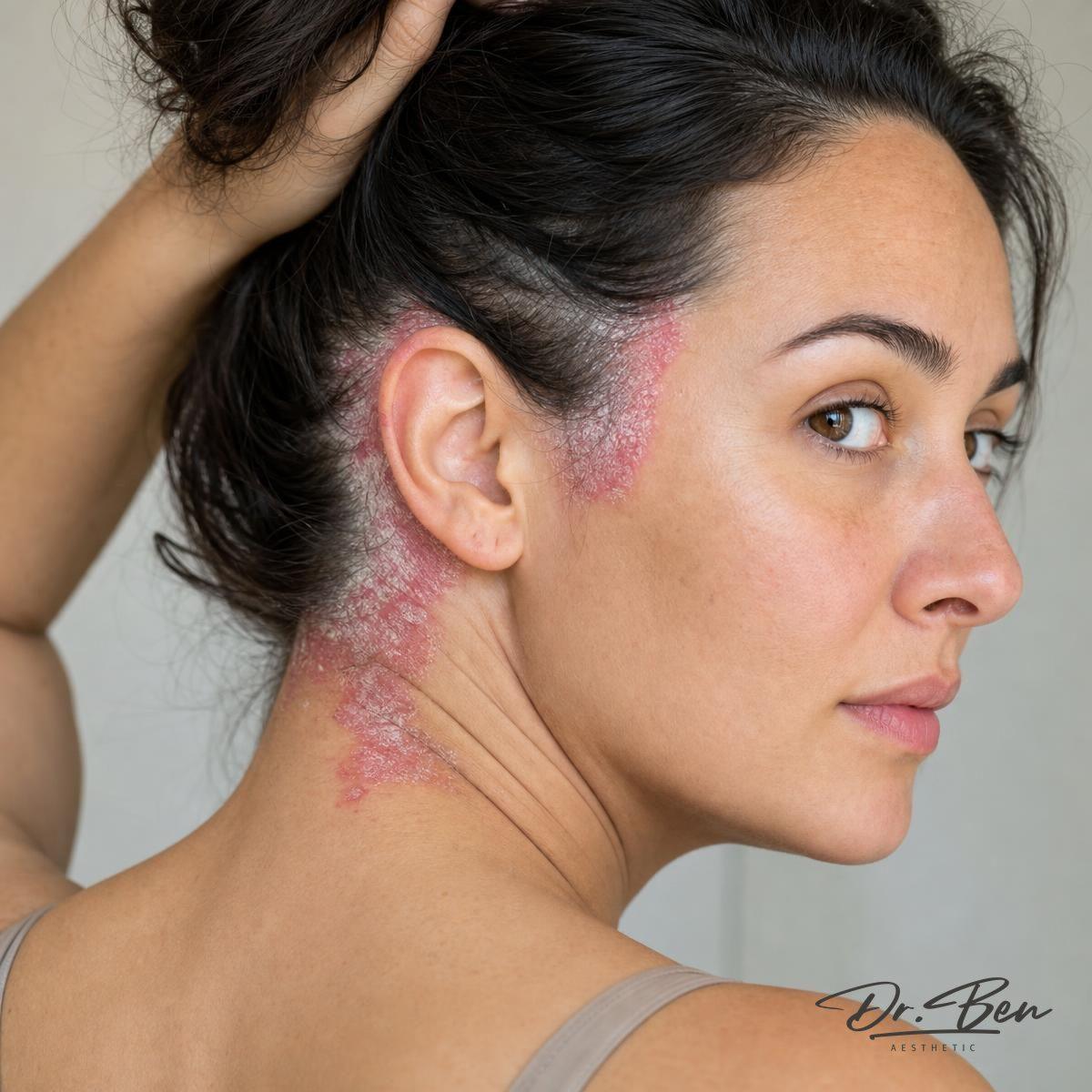
A chronic condition with variable appearance
Psoriasis often affects the elbows, knees, lower back and scalp, but it can also involve skin folds, palms and soles, where it looks quite different. It usually follows a relapsing and remitting course, with periods of improvement and flares that may follow infection, stress, skin injury or changes in medication.
Scalp, nail and joint symptoms
- Scalp involvement, with thick scale that can extend beyond the hairline
- Nail changes such as pitting, thickening, discolouration or separation from the nail bed
- Joint pain and stiffness, particularly early morning stiffness lasting more than about half an hour
- Swelling of a whole finger or toe, or persistent heel pain
Joint symptoms matter because psoriatic arthritis can occur in people with psoriasis and is best assessed early. Persistent joint symptoms should be raised at the consultation so that rheumatology review can be considered.
General health considerations
Psoriasis is associated with other health conditions, including cardiovascular and metabolic conditions, and with a higher rate of depression and anxiety. These associations are stated neutrally: they are a reason for routine general health review with your regular GP, not a cause for alarm.
What happens during the consultation
The consultation reviews when the condition began, how it behaves, which areas are affected, previous treatments and their effect, joint symptoms, current medications and general health. Examination usually includes areas you may not have mentioned, such as the scalp, nails, ears, navel and skin folds, since these help confirm the pattern.
Treatment and management planning
Mild to moderate plaque psoriasis is often managed with topical treatment and consistent skin care, alongside attention to triggers. More extensive or resistant disease, significant scalp, nail, palm or sole involvement, or any joint involvement generally needs specialist input, including phototherapy or systemic and biologic therapy prescribed and monitored by a dermatologist or rheumatologist.
Cosmetic procedures are not a treatment for psoriasis. Injury to the skin can provoke new plaques in some people, so elective procedures are considered carefully and usually only when the condition is settled.
Suitability, limitations and referral
Psoriasis can be controlled but not cured, and treatment often needs to continue. Where disease is extensive, disabling, rapidly worsening or associated with joint symptoms, referral and coordination with your regular GP is the appropriate pathway rather than continuing topical treatment alone.
Preparing for your appointment
- List previous treatments, including phototherapy and any systemic medication
- Note joint symptoms, morning stiffness and any swollen fingers or toes
- Bring a current medication list, since some drugs can aggravate psoriasis
- Remove nail polish so nails can be examined
Next step
Arrange a consultation
Assessment in person is the only way to work out what is causing a skin concern and what can reasonably be done about it. Fees are explained before anything is arranged.
Medical disclaimer
This page is general information only and is not a diagnosis, a treatment recommendation, or a substitute for individual medical advice. Conditions that look similar can have different causes, and what is suitable for one person may not be suitable for another. If you are unwell, in significant pain, or worried about a rapidly changing symptom, seek medical care promptly. In an emergency call 000.
- Written for patients by
- Dr Benyamin Mansoori, cosmetic physician & skin cancer doctor
- Medically reviewed by
- Dr Benyamin Mansoori (MD, FRACGP, FACCSM), AHPRA MED0002097300
- Last medically reviewed