Skin Concerns
Skin Texture & Enlarged Pores Assessment in Melbourne
Visible pores and some uneven texture are normal features of human skin. Genetics, sebum production, acne, ultraviolet light, ageing, inflammation and disruption of the skin barrier can all affect how the surface looks and feels. Having visible pores does not, by itself, mean that your skin is unhealthy or that you need a cosmetic procedure.
Dr Benyamin Mansoori offers doctor-led consultations in Southbank and Malvern, Melbourne, to assess skin concerns and discuss appropriate options. The starting point is understanding your skin, not selecting a procedure. Patient safety, realistic expectations and informed consent guide the discussion; flawless or pore-free skin cannot be guaranteed, and choosing no cosmetic treatment is a valid option.
What Is Uneven Skin Texture?
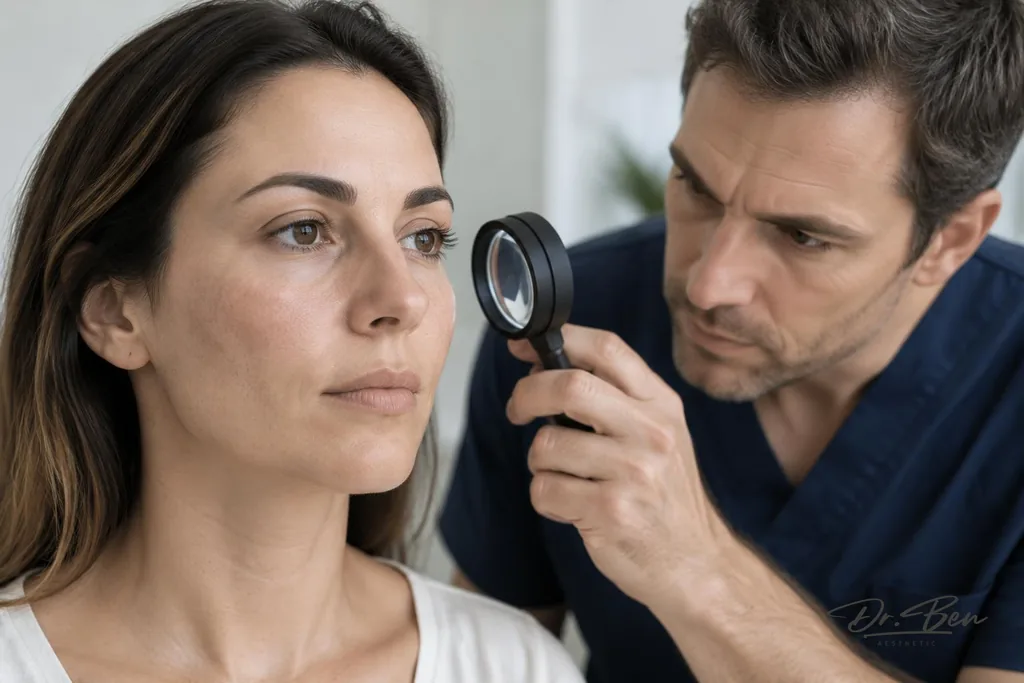
Uneven skin texture describes differences in the surface of the skin, such as roughness, visible pores, small bumps, depressions, dryness, acne scars or fine lines. Some sun-related changes can produce thickened or scaly areas. These appearances can overlap, but they do not necessarily have the same cause.
For example, a bump may be a blocked follicle, an inflammatory lesion or another skin condition, while a depression may represent an acne scar rather than an enlarged pore. A clinical assessment helps distinguish normal skin characteristics from disease and avoids treating an undiagnosed condition as a purely cosmetic concern.
Why Do Facial Pores Appear Enlarged?
Pores are normal openings of hair follicles, many of which contain sebaceous glands that produce oil. Their visibility varies across the face and between individuals. Normal follicular openings cannot be permanently removed.
Genetics and Natural Skin Characteristics
Inherited skin characteristics influence follicle size, oil production and the way pores appear. Pores are often more noticeable on the nose, forehead and central cheeks. This natural variation is not a defect and does not necessarily require treatment.
Sebum Production and Oily Skin
Sebum helps protect and lubricate the skin. Greater oil production can make follicular openings look more prominent, particularly where oil and skin cells collect. Stripping away all oil with harsh cleansers may irritate the skin without removing the underlying follicle.
Acne and Comedones
A build-up of oil and skin cells can obstruct follicles and form comedones. Active acne and inflammation may make surrounding skin appear uneven. Assessment of Acne & Acne Scarring helps separate current breakouts from marks and lasting structural scars, which may need different management.
Ageing and Skin Support
Changes in skin elasticity and supporting tissue with age can alter the appearance of follicular openings. Fine lines and changes in the surrounding skin may also affect perceived texture. These changes are gradual and cannot be reliably reversed to produce permanently smooth skin.
Sun Exposure
Cumulative ultraviolet exposure can affect skin support and contribute to roughness, uneven colour and more noticeable texture. Pigmentation & Sun Damage may occur alongside visible pores, but pigmented or scaly lesions need their own assessment rather than an assumption that they are harmless cosmetic changes.
Enlarged Pores, Blackheads and Sebaceous Filaments
An enlarged-looking pore is a visible follicular opening. A blackhead is an open comedone: oil and skin-cell material obstruct the follicle and the exposed material darkens through oxidation, not because the skin is dirty. Blackheads are a form of acne.
Sebaceous filaments are normal collections of sebum and cells within follicles that help carry oil to the surface. They may look like small, fairly uniform grey, yellowish or pale dots, especially on the nose. Unlike blackheads, they are part of normal follicular function and commonly become visible again after removal.
Repeated squeezing, aggressive extraction or abrasive scrubbing can cause inflammation, broken skin, infection, pigmentation changes and scarring. If you are unsure what you are seeing, a clinician can assess it before you try to remove or treat it.
What Causes Rough or Uneven Skin Texture?
Active Acne
Comedones, inflamed spots and deeper acne lesions can create bumps and irregularity. When active acne is present, managing the underlying condition is usually more important than pursuing a procedure for texture alone. Continuing inflammation can also lead to further marks or scars.
Acne Scarring
Depressed acne scars reflect structural injury in the skin. Rolling scars create broad undulations, boxcar scars have more defined edges, and ice-pick scars are narrow and deep. Different scar types may occur together, and a treatment appropriate for one type may have limited benefit for another.
Dryness and Skin-Barrier Disruption
Dryness, scaling and irritation can make skin feel rough even without prominent pores or scars. Over-cleansing, frequent exfoliation, irritating products and some skin diseases may disrupt the barrier. Restoring comfort and controlling inflammation may be the first priority before considering a cosmetic procedure.
Sun-Related Skin Changes
Long-term sun exposure can contribute to fine lines, changes in skin support and rough or thickened patches. Persistent scaly areas can also represent lesions that require medical investigation. They should not simply be exfoliated away or treated as ordinary texture.
Other Dermatological Conditions
Dermatitis, follicular disorders and disorders of keratinisation can produce bumps, scaling or inflammation that resemble cosmetic texture concerns. Their management depends on the diagnosis. Examination by a clinician, and referral when appropriate, helps avoid unnecessary or aggravating treatment.
How Are Skin Texture and Enlarged Pores Assessed?
The history considers when the changes began, where they occur and whether they fluctuate. Dr Mansoori may ask about your skin type, oil production, acne and scarring, redness, pigmentation, sensitivity, sun exposure and symptoms such as itching, pain or persistent scaling.
Relevant medical history, medicines, allergies, current skin-care products and previous cosmetic procedures are also considered. Bringing a product list and details of previous treatments can help identify possible irritation or factors that affect suitability.
Clinical examination distinguishes follicular openings and sebaceous filaments from comedones, depressed scars, barrier disruption and other skin disease. Further tests or referral are considered only when the findings indicate a need; they are not automatically required for visible pores. A Skin-Quality Consultation can provide a broader assessment when several concerns overlap.
What Happens During Your Consultation?
1. Discussing Your Concerns
You can explain what you have noticed, how long it has been present and what, if anything, you would like help with. Your priorities and expectations are discussed without assuming that a normal skin characteristic needs to be changed.
2. Reviewing Your Medical and Skin-Care History
The discussion covers skin conditions, medicines, allergies, sensitivity, sun exposure and current products, as well as previous cosmetic procedures and their effects. This helps identify underlying disease and factors that may increase treatment risk.
3. Examining Your Skin
An examination assesses the pattern of pores, bumps, scars, colour changes and inflammation. The purpose is to distinguish normal anatomy from acne, barrier problems or other medical conditions rather than rely on a photograph or a product label alone.
4. Developing an Individual Management Plan
The plan may involve gentle skin care, medical acne care, treatment of another diagnosed condition, observation or referral. Cosmetic procedures may be discussed where appropriate, alongside alternatives and the option of no treatment. Not everyone needs a procedure.
5. Discussing Risks, Costs and Consent
Any proposed treatment requires an explanation of its expected limitations, material risks, alternatives, recovery and costs before consent. Consultation Fees are available separately; individual procedure costs are explained before proceeding. You can take time to decide and there is no pressure or obligation to proceed.
What Treatment Options May Be Discussed?
Options depend on the diagnosis, skin type, goals and risk profile. A discussion of a method does not mean that it is suitable for you or available at every consulting location. Service availability must be confirmed, and referral may be more appropriate than treatment within the clinic.
Personalised Skin Care
A gentle cleanser, a suitable moisturiser and regular broad-spectrum sunscreen can support the skin barrier and long-term skin health. The choice and frequency of products should take sensitivity and any active condition into account. Aggressive exfoliation and using several irritating products together may worsen roughness rather than improve it.
Medical Acne Treatment
Medical Acne Treatment may be considered when active acne is contributing to bumps, inflammation or blocked follicles. Management depends on the severity and clinical circumstances, and may help reduce new lesions and the risk of further scarring. It does not remove normal pores or guarantee clearance of existing scars.
Skin Needling
Skin Needling creates controlled small punctures in the skin and may be discussed for selected texture concerns or acne scars. Results vary with the scar pattern, technique and individual healing, and some people obtain little improvement. Suitability, infection risk, pigmentation risk and recovery need assessment first; it is not a way to eliminate normal pores.
Radiofrequency Microneedling
Radiofrequency Microneedling combines needling with energy delivery into the skin. Potential benefit and risk depend on the device, settings, depth and operator, and it is not interchangeable with standard needling. Burns, pigment changes, scarring and deeper tissue injury are possible. Availability varies, and a discussion does not confirm that this procedure is offered at your chosen clinic.
Collagen-Stimulating Treatments
Collagen-Stimulating Treatments describes approaches with different mechanisms, evidence and risk profiles. Evidence for a specific scar or texture concern may be limited, and outcomes cannot be predicted from the category name alone. Any particular option requires a separate suitability assessment and explanation of its material risks; it should not be presented as a reliable cure for enlarged pores.
Other Skin-Quality Procedures
Other procedures may be considered only after establishing the diagnosis, assessing suitability and confirming genuine service availability. A method that targets colour, surface roughness or deeper scars may not address the same problem. Treating active disease, adjusting skin care or choosing no cosmetic procedure may be safer and more appropriate.
Are Enlarged Pores and Acne Scars Treated Differently?
Yes. Pores are natural follicular openings, while depressed acne scars reflect structural skin injury. An enlarged-looking opening and a small depressed scar may appear similar at first glance, but their anatomy and possible management are different.
Care for visible pores may focus on oiliness, comedones, barrier health and realistic expectations. Scar management considers scar depth, shape, distribution, skin type and whether acne remains active. Neither approach can promise completely smooth skin, and applying the same procedure to both concerns may be unhelpful.
Potential Risks of Skin-Texture Treatments
Risks depend on the product or procedure and your skin. They may include soreness, redness, swelling, dermatitis, allergic reactions, prolonged inflammation, infection and increased sensitivity. Some treatments can cause hyperpigmentation or hypopigmentation, burns or scars. Downtime can be longer than expected, and improvement may be limited or fall short of your expectations.
Extra caution is needed with sensitive or irritated skin, active acne or other skin disease, and a history or higher risk of post-inflammatory hyperpigmentation. Darker skin tones require careful consideration of pigment-related risks, but suitability cannot be decided from skin tone alone. Screening, appropriate technique and aftercare may reduce some risks without removing them entirely.
Before deciding, ask about the risks specific to the proposed method, recovery requirements, alternatives and what to do if a complication occurs. Seek prompt medical advice for worsening pain, spreading redness, discharge, fever or other signs of infection after a procedure.
Can Enlarged Pores Be Permanently Closed?
No. Normal pores cannot be physically removed or permanently closed by a skin-care product or cosmetic procedure. They are functional openings, not holes that need to be sealed.
Managing acne, oiliness or surrounding skin changes may make pores less noticeable for some people, but any cosmetic improvement is limited and individual. Appearance can change over time, and claims of permanent pore removal or guaranteed pore-free skin are misleading.
Realistic Expectations and Long-Term Skin Health
Healthy skin has texture, visible follicles and natural variation. No treatment can promise permanently flawless skin or stop normal ageing. Decisions are better based on comfort, skin health and achievable goals than on filtered images or pressure to look pore-free.
Consistent sunscreen use, gentle skin care and treatment of underlying skin disease can support long-term skin health. Improvement, where possible, may take time and may not be uniform. You can choose observation, adjust your routine or decline a cosmetic procedure altogether.
When Should Skin Changes Be Medically Investigated?
Arrange medical assessment for a new or changing lesion, a persistent rough or scaly patch, a bleeding or non-healing sore, rapid change, ongoing pain or signs of infection. These findings should not automatically be attributed to pores, acne or ordinary texture.
Depending on the examination, skin cancer assessment or another medical investigation may be indicated. A cosmetic texture procedure should not delay assessment of a suspicious lesion. Seek prompt care if redness or swelling spreads, pain is severe or you feel unwell; in an emergency call 000.
Skin Texture & Enlarged Pores Consultations in Melbourne
Dr Benyamin Mansoori consults at Capstone Medical Centre Southbank, 216 City Road, Southbank VIC 3006, and at Cosmetic Avenue Malvern, 1308 Malvern Road, Malvern VIC 3144. These are independent consulting locations; appointment availability and the assessment or treatment options available are subject to the individual clinic.
Check the relevant location information when arranging an appointment. A consultation provides an opportunity to discuss your skin concerns, review your history and consider whether medical care, skin-care changes, referral or no procedure is appropriate.
Arrange a Skin-Quality Consultation
If you would like an assessment of uneven texture or visible pores, you can arrange a consultation with Dr Mansoori. The discussion begins with your concerns and an examination, with any suitable options, limitations and costs explained before you make a decision. Booking a consultation does not commit you to a cosmetic procedure.
This page provides general information only. It is not a diagnosis, a recommendation for a particular procedure or a substitute for individual medical advice. Skin changes with similar appearances can have different causes, and suitability must be assessed in person.
Common questions
- What causes enlarged pores?
- Pore visibility can be influenced by genetics, follicle size, oil production, comedones, ageing and sun-related changes in surrounding skin. Pores are normal structures; assessment can help distinguish them from acne or scars.
- Can enlarged pores be permanently removed?
- No. Normal follicular openings cannot be permanently removed or closed. Some care may make them less noticeable in individual cases, but pore-free skin cannot be guaranteed.
- Are enlarged pores the same as blackheads?
- No. A pore is a normal follicular opening. A blackhead is an open comedone caused by an obstruction of oil and skin cells; the exposed material darkens through oxidation rather than dirt.
- What are sebaceous filaments?
- They are normal collections of sebum and cells within follicles that help carry oil to the surface. They can look like small, uniform dots, particularly on the nose, and commonly become visible again after removal.
- Can oily skin make pores look larger?
- Greater sebum production can make follicular openings appear more prominent. Harsh cleansing does not remove the follicle and may cause irritation; an appropriate routine should support the skin barrier.
- Can acne cause uneven skin texture?
- Yes. Comedones and inflamed lesions can cause bumps, and some acne leaves structural scars. Active acne and established scars need different assessment, and managing acne may help reduce further injury.
- Is skin needling suitable for enlarged pores?
- It may be discussed for selected texture concerns or scars after assessment, but it does not eliminate normal pores. Benefits vary, and infection, pigmentation changes and scarring are among the risks that need consideration.
- Can skin-care products improve skin texture?
- Suitable products may help dryness, barrier disruption or some acne-related changes. The choice depends on the cause and your sensitivity; products cannot permanently remove pores or reliably erase depressed scars.
- Does exfoliating every day reduce pore size?
- Daily exfoliation is not necessary for everyone and cannot permanently shrink normal follicles. Over-exfoliation can cause irritation, barrier damage and pigmentation changes, so frequency should be tailored to your skin.
- Can treatments make acne scars completely disappear?
- Complete disappearance cannot be promised. Some selected scars may improve, but results depend on scar type, skin characteristics, treatment and healing, and residual texture commonly remains.
- Are skin-texture treatments suitable for darker skin tones?
- Some options may be suitable after individual assessment. Pigmentation changes are an important risk, and the choice of method, settings and aftercare needs care. No procedure is automatically suitable or unsuitable based on skin tone alone.
- Do I need a cosmetic procedure for enlarged pores?
- No. Visible pores are normal, and choosing no procedure is valid. Gentle skin care or management of an underlying condition may be enough; a consultation can help clarify the cause without an obligation to proceed.
Next step
Arrange a consultation
Assessment in person is the only way to work out what is causing a skin concern and what can reasonably be done about it. Fees are explained before anything is arranged.
Medical disclaimer
This page is general information only and is not a diagnosis, a treatment recommendation, or a substitute for individual medical advice. Conditions that look similar can have different causes, and what is suitable for one person may not be suitable for another. If you are unwell, in significant pain, or worried about a rapidly changing symptom, seek medical care promptly. In an emergency call 000.
- Written for patients by
- Dr Benyamin Mansoori, cosmetic physician & skin cancer doctor
- Medically reviewed by
- Dr Benyamin Mansoori (MD, FRACGP, FACCSM), AHPRA MED0002097300
- Last medically reviewed