Skin Concerns
Acne, Acne Marks & Scarring Assessment in Melbourne
Dr Benyamin Mansoori offers doctor-led assessment of acne, acne marks and acne scarring at consulting locations in Southbank and Malvern, Melbourne.
Acne affects both teenagers and adults. It can range from blackheads and whiteheads to inflamed spots and deeper, painful lesions. After acne settles, the skin may show residual redness, changes in pigmentation or true structural scarring.
These changes look similar but are different, and distinguishing between them comes before any discussion of options. The aim of the consultation is medical assessment, long-term skin health and informed decision-making. No procedure is required as part of an assessment.
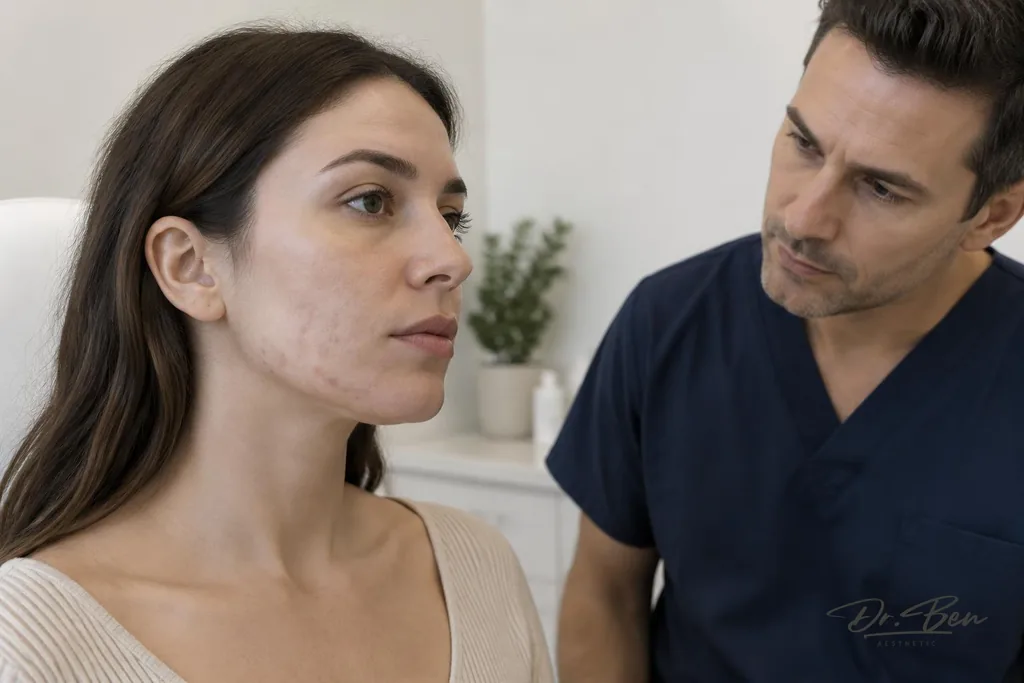
Understanding Acne and Its Effects on the Skin
Acne involves inflammation of the hair follicles and their associated oil (sebaceous) glands. It most commonly affects the face, chest and back, where these glands are most active.
Acne lesions are commonly described as:
- Comedones — blackheads (open) and whiteheads (closed) caused by blocked follicles
- Papules — small, raised, inflamed bumps
- Pustules — inflamed spots containing visible pus
- Nodules — larger, deeper and often painful lesions beneath the skin
- Cysts — deeper inflammatory lesions that carry a higher risk of scarring
The pattern, distribution and severity of these lesions help guide the management plan.
What Can Cause Acne?
Acne is multifactorial. Contributing factors may include:
- Hormonal influences
- Genetic tendency
- Sebum (oil) production
- Changes in how skin cells shed inside the follicle (follicular keratinisation)
- Inflammatory and bacterial factors in the skin
- Certain medicines
- Occlusive skincare or cosmetic products, and friction from clothing or equipment
- Lifestyle and environmental factors
Stress may aggravate acne in some people. Evidence linking specific foods to acne is limited and varies between individuals. Acne is not simply the result of poor hygiene, and over-washing can irritate the skin.
Understanding Different Types of Acne Marks and Scars
A key part of assessment is distinguishing residual pigment, residual vascular redness and structural scarring. Marks caused by pigment or redness are not, by definition, permanent scars, and they are often managed differently from changes in skin texture.
Post-Inflammatory Hyperpigmentation
Brown or grey-brown marks can remain after an inflamed spot settles. They are more common in deeper skin tones and may fade gradually over months, particularly with sun protection and by avoiding further inflammation. Related concerns are discussed on Pigmentation & Sun Damage.
Post-Inflammatory Erythema
Pink, red or violaceous marks reflect residual redness from dilated blood vessels after inflammation. These marks are flat and often improve with time, but can persist.
Atrophic Acne Scars
Atrophic scars are depressions caused by loss of tissue during healing. They are commonly described as:
- Ice-pick scars — narrow, deep scars that extend into the skin
- Boxcar scars — broader depressions with sharper, defined edges
- Rolling scars — broader, shallow depressions that give the skin a wavy appearance
Many people have a mixture of scar types. Changes in surface texture overlap with concerns discussed on Skin Texture & Enlarged Pores.
Raised Acne Scars
Hypertrophic scars are raised and remain within the original area of injury. Keloid scars extend beyond it and are more common on the chest, shoulders and jawline in people with a predisposition.
Each of these changes has different implications, and an approach suited to one type may be unsuitable for another.
Why Is Early Acne Assessment Important?
Active inflammatory or nodular acne can leave permanent scarring. Assessment may be worthwhile if you have:
- Painful nodules or deep lesions
- Acne that is worsening or persisting
- Early signs of scarring
- Acne that has not improved with over-the-counter products
- Acne that began in adulthood
- Acne affecting your confidence, mood or wellbeing
- Features that may suggest a hormonal or endocrine cause, such as irregular periods or excess hair growth
Early, appropriate management may help reduce avoidable scarring. Detail on treating active acne is available on Medical Acne Treatment.
What Happens During an Acne and Acne-Scarring Consultation?
Step 1: Identifying active acne, marks and scars
The first step is working out whether your concern is active acne, residual marks, structural scarring or a combination.
Step 2: Medical and skin history
This includes how long acne has been present, previous medicines and skincare products, allergies, current medications, family history and any hormonal changes.
Step 3: Clinical examination
The skin is examined to assess severity, distribution and pattern, and to consider other conditions that can resemble acne.
Step 4: Individualised management plan
A plan may include medical care, skincare guidance and, where appropriate, referral.
Step 5: Options, risks and informed consent
Realistic options, risks, alternatives (including no treatment) and fees are explained so you can make an informed decision. There is no pressure to proceed. Current fees are listed under Consultation Fees.
Should Active Acne Be Treated Before Acne Scars?
Controlling active inflammatory acne is often prioritised before elective scar-directed procedures, because ongoing inflammation can create new marks and scars and may affect healing. The timing is individualised and depends on your skin, history and goals.
What Management Options May Be Considered?
Medical Management of Active Acne
Management depends on severity and may include skincare guidance and medical treatment options discussed during consultation. Severe acne may require specialist involvement. Specific prescription-only medicines are discussed individually during consultation, not on this page.
Management of Post-Acne Pigmentation
The approach considers the type of pigment, your skin tone, sun exposure and the risk of further post-inflammatory pigmentation. Daily photoprotection is an important foundation.
Management of Persistent Redness
Persistent redness is assessed for its underlying cause, as conditions such as rosacea or sensitive skin may contribute alongside post-acne redness.
Acne Scar Assessment
Scar-directed options depend on scar morphology, depth, skin type and medical history. Approaches such as Skin Needling, certain laser treatments, subcision or other specialist-directed techniques may be discussed where appropriate. Not every technique is offered at every location, and not every option suits every scar. More detail is available on Acne Scar Assessment.
Specialist Referral
Referral to a dermatologist or other specialist may be recommended for severe acne, complex scarring or where the diagnosis is uncertain.
Potential Risks and Treatment Limitations
Acne and scar treatments carry potential risks, which may include:
- Skin irritation and dryness
- Swelling, redness or tenderness
- Allergic reaction or infection
- Post-inflammatory hyperpigmentation or hypopigmentation
- Scarring or skin injury
- An outcome that does not meet expectations
Each treatment has its own specific risks, and some carry additional considerations for deeper skin tones. No treatment can guarantee complete removal of acne scars.
Skin Care and Prevention of Further Skin Damage
- Gentle cleansing
- Regular moisturising
- Daily sun protection
- Avoiding picking or squeezing spots
- Avoiding over-irritating the skin
Guidance is individualised. Using too many active products at once can increase irritation and may worsen marks. Broader skin concerns can also be reviewed through a Skin-Quality Consultation.
Realistic Expectations for Acne Scarring
Pigment and redness marks may fade over time, whereas structural scars tend to persist. Response to treatment varies between individuals, and not all scars respond to the same approach. Improvement, where achieved, is usually gradual. You are under no pressure to undergo any procedure.
Acne and Acne-Scarring Consultations in Melbourne
Dr Ben consults at Capstone Medical Centre Southbank, 216 City Road, Southbank VIC 3006, and at Cosmetic Avenue Malvern, 1308 Malvern Road, Malvern VIC 3144.
Each site operates independently. Please confirm appointment availability and the services offered at your preferred location when booking.
Arrange an Acne and Acne-Scarring Assessment
A doctor-led consultation can clarify whether your concern relates to active acne, marks or scarring, and which options, if any, may be suitable. Follow-up, tests or referral may be recommended.
Outcomes vary between individuals, and all treatments carry risks. Any decision about treatment is made by you after informed discussion.
Common questions
- What is the difference between acne marks and acne scars?
- Acne marks are flat changes in colour, such as brown pigmentation or pink-red redness, left after inflammation. Acne scars are changes in skin structure, either depressed (atrophic) or raised. Marks may fade over time, while structural scars tend to persist.
- Can acne scars disappear naturally?
- Pigment and redness marks often fade gradually. Structural scars generally do not disappear on their own, although their appearance may change over time.
- Can acne scarring be prevented?
- Not always, but early and appropriate management of inflammatory acne, and avoiding picking or squeezing spots, may help reduce the risk of avoidable scarring.
- Should active acne be treated before scar procedures?
- Controlling active inflammatory acne is often prioritised before elective scar-directed procedures, but timing is individualised and discussed during consultation.
- Are ice-pick, boxcar and rolling scars treated differently?
- They can be. Each scar type differs in depth and shape, so an approach suited to one type may be less suitable for another. Many people have a mixture, which is assessed individually.
- Can acne cause permanent pigmentation?
- Post-inflammatory hyperpigmentation often fades over months, but it can persist in some people, particularly with ongoing inflammation or sun exposure. Assessment helps distinguish pigment from other changes.
- Can adults develop acne?
- Yes. Acne can begin or continue in adulthood. Adult-onset acne may warrant assessment for contributing factors, including hormonal causes.
- Can skin needling help with acne scars?
- Skin needling may be discussed for some atrophic scars, depending on scar type, skin type and medical history. It is not suitable for everyone, carries risks and does not guarantee a particular result.
- How many treatments are needed for acne scars?
- There is no set number. It depends on scar type and depth, the approach used, skin type and individual response, and is discussed after assessment.
- Can all acne scars be completely removed?
- No treatment can guarantee complete removal of acne scars. The aim, where treatment is appropriate, is improvement, and results vary between individuals.
- Is acne-scar treatment suitable for darker skin tones?
- Some approaches may be suitable, but deeper skin tones can carry a higher risk of pigment changes after certain treatments. Skin tone is considered carefully when discussing options.
- Do I need to have a procedure at my first appointment?
- No. The first appointment focuses on assessment, discussion and informed decision-making. You are under no obligation to proceed with any procedure.
Next step
Arrange a consultation
Assessment in person is the only way to work out what is causing a skin concern and what can reasonably be done about it. Fees are explained before anything is arranged.
Medical disclaimer
This page is general information only and is not a diagnosis, a treatment recommendation, or a substitute for individual medical advice. Conditions that look similar can have different causes, and what is suitable for one person may not be suitable for another. If you are unwell, in significant pain, or worried about a rapidly changing symptom, seek medical care promptly. In an emergency call 000.
- Written for patients by
- Dr Benyamin Mansoori, cosmetic physician & skin cancer doctor
- Medically reviewed by
- Dr Benyamin Mansoori (MD, FRACGP, FACCSM), AHPRA MED0002097300
- Last medically reviewed