Consultation & Facial Planning
Facial Contouring & Volume Assessment in Melbourne
Facial shape reflects the relationship between bone structure, fat, muscles and skin. Ageing, weight changes and individual anatomy can affect the appearance of the cheeks, temples, chin and jawline. A concern about one feature does not necessarily mean that adding volume or having a cosmetic procedure is appropriate.
Dr Ben Mansoori provides personalised, doctor-led facial contouring and volume assessment in Southbank and Malvern, Melbourne. The consultation considers your concerns, medical history, previous treatments and the face as a whole before discussing whether any options are suitable. There is no obligation to proceed, and no particular appearance or outcome can be guaranteed.
What Is Facial Contouring and Volume Assessment?
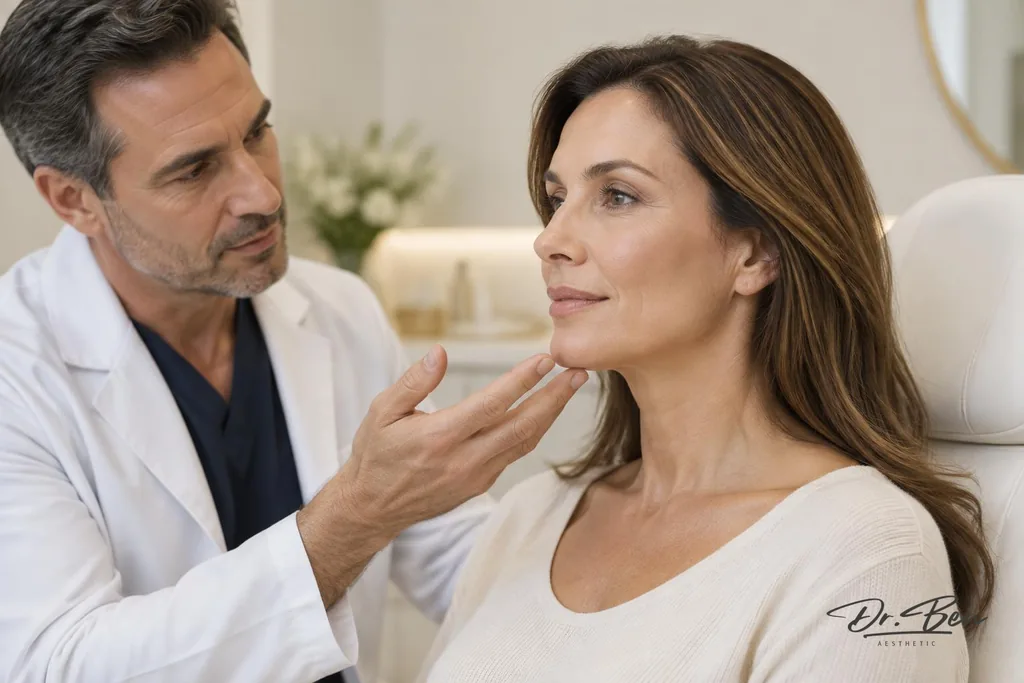
Facial contouring and volume assessment is a medical consultation about facial shape, proportions and areas that appear fuller, flatter or less defined. Contour describes the outline and relationships between features; volume describes fullness within the tissues. The two are related, but they are not interchangeable.
Assessment aims to understand what contributes to your concern rather than assume that a particular procedure will address it. Bone structure, tissue support, skin laxity and facial movement may all be relevant. A cosmetic consultation and facial assessment provides the broader framework for discussing your priorities, realistic limitations and alternatives, including no treatment.
Common Areas of Facial Volume and Contour Concern
People may seek advice about one area or several related features. Areas commonly discussed include:
- Cheeks and mid-face: changes in fullness or support, differences between sides, or the relationship between the cheeks and lower eyelids. An under-eye assessment may be relevant when the concern involves this adjoining area.
- Temples: hollowing or changes in the transition between the forehead and upper face. This area has important blood vessels and requires careful assessment.
- Chin and profile: chin projection and proportions in relation to the nose, lips and lower face. A lip consultation may help distinguish a lip-specific concern from an issue involving the wider profile.
- Jawline: changes in definition, lower-face proportions or skin laxity. Reduced definition is not always caused by a lack of volume, and adding fullness may not address the cause.
- Asymmetry: differences in shape, position or movement between the two sides. Some asymmetry is normal; a new or unexplained change may need medical assessment rather than cosmetic treatment.
Facial movement and skin quality can influence how contours appear. An expression-line consultation or skin-quality consultation may be more relevant when the main concern is movement-related lines, texture or laxity rather than volume.
Why Is a Whole-Face Assessment Important?
A feature can look different depending on the structures around it. Focusing on a single hollow or contour without considering the rest of the face can overlook the underlying cause or create a disproportionate change elsewhere.
Dr Ben considers the upper, middle and lower face together, including front and profile views, resting appearance and movement where relevant. Assessment also considers your individual characteristics and preferences, rather than applying a fixed ideal or assuming that fuller features are preferable.
The discussion may identify limits that a non-surgical procedure cannot reasonably address. A staged approach, further investigation, referral or no treatment may be more appropriate. Assessment does not guarantee symmetry, a particular degree of definition or a natural-looking result.
What Happens During Your Consultation?
The consultation is guided by your concerns and clinical circumstances. It generally includes five assessment and decision-making steps:
- Discussing your concerns and priorities: explain what has changed, which areas you are concerned about and what you hope to understand or achieve. Expectations are considered without assuming that treatment is needed.
- Reviewing medical history and previous procedures: discuss health conditions, medicines, allergies, pregnancy or breastfeeding where relevant, previous cosmetic treatments and any complications. Bring available treatment records and dates; do not stop prescribed medicines without medical advice.
- Examining facial structure and tissues: assess proportions, contour, volume distribution, skin quality and movement where appropriate. Clinical photographs may be discussed and require your consent.
- Considering suitable options and alternatives: explain the likely benefits, limitations, procedure-specific risks and costs of any option that may be appropriate. This can include no treatment, postponement, further assessment or referral.
- Supporting an informed decision: allow questions, check your understanding and discuss any preparation, recovery and follow-up requirements. Consent is a process, not simply a signature; you may take time to consider your options or decide not to proceed.
Risks and Limitations of Facial Contouring Procedures
The risks depend on the procedure, the area being considered, your anatomy and medical history. A consultation cannot remove those risks, and a suitable option for one person may be unsuitable for another. The following is general information, not a complete consent discussion or a recommendation for a particular procedure.
- Some procedures can cause pain, swelling, bruising, tenderness or temporary changes in sensation. Recovery and the duration of any effect vary, and downtime cannot be predicted exactly.
- Depending on the procedure, infection, bleeding, allergic reactions, scarring, pigment changes or persistent inflammation may occur. These can require further medical care.
- Procedures that alter tissue volume may cause lumps, nodules, unevenness, unwanted fullness, movement of material or delayed reactions. Changes may be difficult to correct or may not be fully reversible.
- For procedures involving material placed into facial tissues, rare but severe vascular events can occur if blood supply is obstructed. Consequences can include skin injury or tissue death and, in rare cases, loss of vision or stroke. These are medical emergencies; discussing them is an essential part of informed consent where relevant.
- Residual or increased asymmetry, an unsatisfactory appearance or a change that differs from your expectations is possible. Additional procedures may involve further cost and risk, and correction cannot be guaranteed.
Volume changes do not necessarily correct skin laxity, movement-related concerns or underlying skeletal proportions. Suitability may be affected by active infection, health conditions, medicines, previous procedures or expectations. Any recommendation requires individual assessment; this page does not promote a prescription medicine or establish eligibility for treatment.
Previous Cosmetic Treatments and Facial Volume Concerns
Previous cosmetic procedures can affect facial shape and the interpretation of an examination, even when they were performed some time ago. Tell Dr Ben about previous products or procedures, treatment areas, dates and any symptoms, and bring records if you have them. If details are unknown, say so rather than guessing.
Previous filler concerns such as persistent swelling, lumps, unevenness or a change in contour need assessment before considering further procedures. Ultrasound assessment and filler dissolving may be discussed where clinically indicated, but ultrasound is not required for every consultation and dissolving is not automatically suitable or available. Investigation has limitations, and correction may be incomplete or carry additional risks.
Do not wait for a routine cosmetic appointment if you develop severe or worsening pain, unusual skin discolouration or visual symptoms after a procedure. Seek urgent medical care; sudden loss of vision or stroke-like symptoms require emergency assistance by calling 000.
Southbank and Malvern Consulting Locations
Dr Ben consults at Capstone Medical Centre Southbank, 216 City Road, Southbank VIC 3006, and Cosmetic Avenue Malvern, 1308 Malvern Road, Malvern VIC 3144. These are independent clinics where he sees patients, not clinics owned by Dr Ben Aesthetic.
The doctor consultation fee is $150. Fees & Pricing explains consultation charges and how individual treatment or procedure fees are provided after assessment. Fees must be explained before proceeding, and there is no obligation to have treatment.
Considering a Facial Contouring Consultation?
An in-person consultation can help clarify what contributes to your facial contour or volume concern and what can reasonably be considered. Bring your questions and any previous treatment information. The next step may be further assessment, time to reflect, referral or no treatment; a procedure or a particular outcome is never assured.
Common questions
- What causes facial volume loss?
- Ageing can change facial fat distribution, bone support and skin elasticity. Weight changes, individual anatomy, some health conditions and previous procedures may also affect appearance. An examination is needed to understand your concern; a new, rapid or unexplained change should be assessed medically rather than assumed to be cosmetic.
- Can facial contouring make my face completely symmetrical?
- No procedure can guarantee perfect symmetry. Differences between the two sides of the face are common and may involve bone, soft tissues or movement. Assessment considers whether a concern can reasonably be addressed, but asymmetry may remain or become more noticeable after a procedure.
- What is the difference between contouring and volumising?
- Contouring concerns facial shape, outlines and the relationship between features. Volumising refers to changing fullness in an area. Adding volume can affect contour, but not every contour concern is caused by volume loss, and extra fullness may be inappropriate. The consultation considers the underlying cause before discussing options.
- Can I discuss several areas during one consultation?
- Yes. A whole-face assessment can consider related concerns involving areas such as the cheeks, temples, chin and jawline. Explain your priorities when arranging the appointment. The scope of assessment depends on your needs and the time available; further appointments or a staged discussion may be appropriate.
- What if I have had previous cosmetic treatments?
- Tell Dr Ben about all previous procedures, including approximate dates, areas, products if known and any complications. Bring available records. Previous treatment can affect assessment and suitability, and additional investigation or review may be needed before any further procedure is considered.
- How is eligibility for a facial contouring procedure decided?
- Eligibility depends on individual medical history, examination, the proposed procedure and applicable requirements. Anatomy, health conditions, medicines, pregnancy or breastfeeding, previous treatments and expectations may affect suitability. Dr Ben may advise postponement, no treatment, further assessment or referral; booking a consultation does not establish eligibility.
- Can I have treatment on the same day?
- Do not assume that a procedure will be available or appropriate on the day. Any decision depends on assessment, suitability, informed consent and applicable requirements. A separate appointment, further information or time for reflection may be needed. There is no obligation or pressure to proceed.
Next step
Arrange a consultation
Assessment in person is the only way to work out what is causing a skin concern and what can reasonably be done about it. Fees are explained before anything is arranged.
Medical disclaimer
This page is general information only and is not a diagnosis, a treatment recommendation, or a substitute for individual medical advice. Conditions that look similar can have different causes, and what is suitable for one person may not be suitable for another. If you are unwell, in significant pain, or worried about a rapidly changing symptom, seek medical care promptly. In an emergency call 000.
- Written for patients by
- Dr Benyamin Mansoori, cosmetic physician & skin cancer doctor
- Medically reviewed by
- Dr Benyamin Mansoori (MD, FRACGP, FACCSM), AHPRA MED0002097300
- Last medically reviewed