Consultation & Facial Planning
Cosmetic Consultation & Facial Assessment in Melbourne
A cosmetic consultation gives you time to discuss what concerns you and ask questions before deciding whether to consider treatment. Dr Benyamin Mansoori, a cosmetic physician and skin cancer doctor, provides personalised, doctor-led consultations in Southbank and Malvern, Melbourne.
Facial assessment considers your face as a whole, alongside your medical history, previous treatments and priorities. The purpose is to understand what may be suitable for you, including the option of no treatment. Outcomes vary, and no particular appearance or result can be guaranteed.
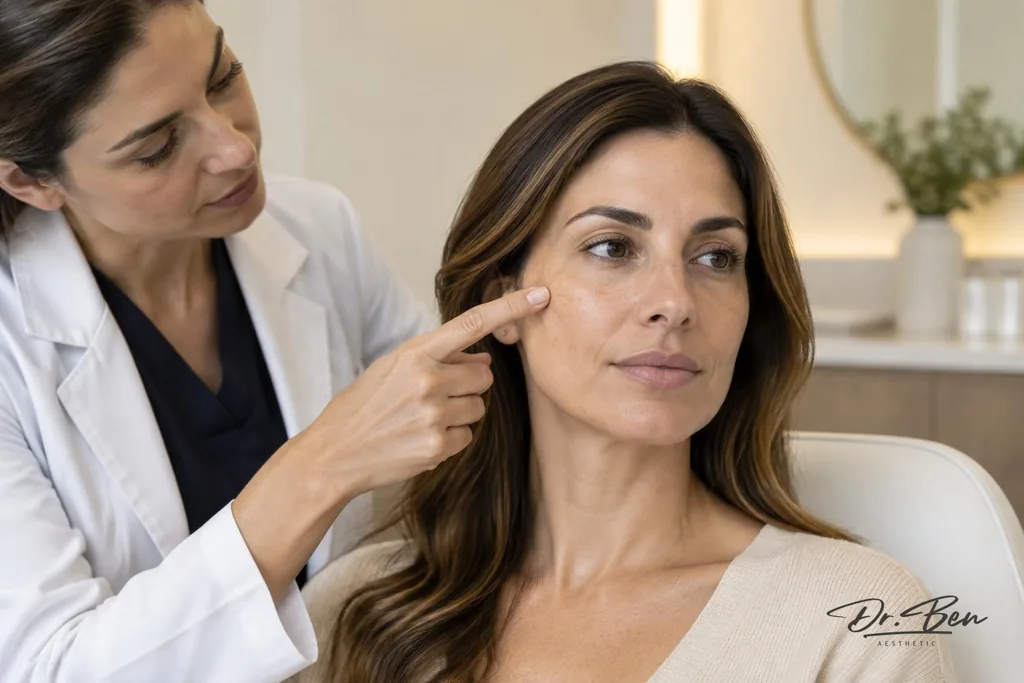
What Is a Cosmetic Consultation?
A cosmetic consultation is a medical appointment to explore an appearance-related concern, assess possible contributing factors and discuss whether any intervention is appropriate. It is not a commitment to a procedure or an opportunity to choose a treatment without assessment.
You may have a specific question about one area, or want to understand several changes together. Dr Ben considers facial proportions, movement, skin quality and your individual circumstances rather than assuming that everyone with a similar concern needs the same approach.
A useful outcome may be a clearer understanding of your concerns, a plan to consider later, advice about non-procedural options, or a recommendation not to proceed. Treatment is not always necessary or suitable.
What Happens During Your Consultation?
The discussion is tailored to you. These five stages help guide an assessment; their order and depth may vary according to your needs.
- Your concerns and priorities: explain what you have noticed, how it affects you and what you hope to understand or change. Discussing expectations helps identify whether an outcome is realistic; you do not need to arrive knowing which treatment to request.
- Your medical history: discuss health conditions, medicines, supplements, allergies and previous procedures, including any complications. Pregnancy, breastfeeding, skin problems and healing difficulties may affect suitability. Bring details of previous cosmetic treatments where available, and do not stop prescribed medicines without advice from your treating clinician.
- Facial examination: assessment may consider your face at rest and during natural movement, including proportions, symmetry, contours, volume distribution and skin quality. Normal differences between the two sides of the face are considered, not treated as a promise that perfect symmetry can be achieved.
- Options and alternatives: where appropriate, discuss possible approaches, what they may and may not address, procedure-specific risks, recovery, follow-up and likely costs. Alternatives may include skin care, observation, no treatment or assessment by another appropriately qualified practitioner.
- Informed decisions: ask questions and take time to consider the information. Fees and the proposed plan should be clear before you decide. Consent is an ongoing discussion, not simply signing a form, and you may choose not to proceed.
Areas Commonly Discussed During Facial Assessment
The following topics can be discussed as part of a whole-face assessment. A topic appearing here does not mean that a procedure will be offered or that it is suitable for you.
- Expression-line consultation: lines around the forehead, frown and eyes may be considered alongside natural facial movement, existing skin changes and your expectations.
- Facial contouring and volume assessment: changes in cheek, chin or jawline contours are considered in relation to overall facial proportions. Not every perceived volume change needs an intervention.
- Lip consultation: discussion may include lip shape, proportions, asymmetry and previous treatment. Anatomy and function matter, and an exact shape or size cannot be promised.
- Under-eye assessment: hollowing, puffiness, pigmentation and skin changes can have different causes. Some concerns require a different type of assessment or are not suitable for a cosmetic procedure.
- Skin quality: texture, hydration and changes in skin appearance can be discussed alongside skin care and sun protection. Questions about skin boosters and collagen-stimulating treatments require individual assessment of suitability, limitations and risks; they are not recommendations for everyone.
Risks, Limitations and Treatment Suitability
All procedures have limitations and potential harms. Suitability depends on the particular procedure, the area being assessed, your anatomy, health, previous treatments and expectations. A consultation cannot guarantee that you will be eligible for treatment or that a desired result can be achieved.
Depending on the procedure, risks may include discomfort, redness, swelling, bruising, infection, pigment changes, scarring, asymmetry or an unsatisfactory result. Some procedures carry less common but serious risks, such as injury to blood vessels or nerves, damage to surrounding tissue or visual complications. This is not a complete risk list: the risks relevant to a proposed procedure need to be explained individually, including possible further treatment or referral if a complication occurs.
Recovery and outcomes differ between people. Changes may be subtle, temporary or less noticeable than expected, and further appointments may be needed. Treatment cannot stop ageing or reliably reproduce a photograph, filter or another person's appearance.
A procedure may be deferred or not recommended where health factors, an active skin problem, previous complications or unrealistic expectations make proceeding inappropriate. Further information, medical assessment or referral may be needed before a decision can be made.
Alternatives include doing nothing, allowing time to consider the concern, non-procedural skin care or seeking another opinion. Where a possible treatment involves a prescription-only medicine, suitability and associated costs are discussed privately during medical consultation rather than promoted as a standard online option.
Consultation Locations and Fees
Dr Ben consults at Capstone Medical Centre Southbank, at 216 City Road, Southbank VIC 3006, and Cosmetic Avenue Malvern, at 1308 Malvern Road, Malvern VIC 3144. These are independent consulting locations, not clinics owned by Dr Ben Aesthetic. Check the relevant location page and confirm appointment arrangements before attending.
The doctor consultation fee is $150. The Fees & Pricing page explains consultation fees and individual treatment quotes. Treatment and procedure fees are provided after consultation, and fees should be explained before proceeding. There is no obligation to have treatment.
Considering a Cosmetic Consultation?
If you would like to understand an appearance-related concern, a consultation with Dr Ben can help you discuss your priorities, available options, potential risks and expected costs. Bring your questions and take the time you need to make an informed decision. Choosing not to proceed is a valid outcome.
Common questions
- Am I obliged to have treatment after a consultation?
- No. The consultation is an opportunity to understand your concerns and consider options. You may take time to decide, seek another opinion or choose no treatment. The consultation fee still applies, but attending does not commit you to a procedure.
- Can I discuss more than one concern?
- Yes, you can raise several concerns so they can be considered together. Mention your priorities when arranging the appointment. The depth of assessment will depend on your needs and the time available; further appointments may be appropriate rather than trying to resolve everything at once.
- How should I prepare for my consultation?
- Bring a list of medicines and supplements, relevant health information and details of previous cosmetic procedures, including products or dates if known. Think about the questions you want to ask and the changes you have noticed. Confirm any appointment-specific preparation with the consulting location, and do not stop prescribed medicines without medical advice.
- Can I have treatment on the same day?
- Do not assume that treatment will be available or appropriate on the day. Any decision depends on assessment, suitability, informed consent, the procedure involved and applicable requirements. Additional information, a separate appointment or time for reflection may be needed. There is no pressure to proceed at your consultation.
- What happens if an option is not suitable for me?
- Dr Ben can explain why an option is not recommended and discuss appropriate alternatives, which may include no treatment, postponement or referral. A requested procedure is not automatically offered, and no specific result can be guaranteed.
- Will my consultation be confidential?
- Your consultation and medical information are handled as confidential health information, subject to applicable privacy laws and professional obligations. Confidentiality is not absolute: disclosure may be required or permitted by law in particular circumstances. Ask how information or any clinical photographs would be collected, stored and used; attending does not give permission to use your images in advertising.
Next step
Arrange a consultation
Assessment in person is the only way to work out what is causing a skin concern and what can reasonably be done about it. Fees are explained before anything is arranged.
Medical disclaimer
This page is general information only and is not a diagnosis, a treatment recommendation, or a substitute for individual medical advice. Conditions that look similar can have different causes, and what is suitable for one person may not be suitable for another. If you are unwell, in significant pain, or worried about a rapidly changing symptom, seek medical care promptly. In an emergency call 000.
- Written for patients by
- Dr Benyamin Mansoori, cosmetic physician & skin cancer doctor
- Medically reviewed by
- Dr Benyamin Mansoori (MD, FRACGP, FACCSM), AHPRA MED0002097300
- Last medically reviewed