Skin Concerns
Skin Laxity & Facial Firmness Assessment in Melbourne
Dr Benyamin Mansoori provides doctor-led assessment of skin laxity and reduced facial firmness in Southbank and Malvern, Melbourne. Skin laxity describes reduced firmness and elasticity influenced by collagen, elastin and deeper anatomy. It is often part of normal ageing and may be noticed around the cheeks, jawline, neck or other areas.
Skin laxity is not necessarily a medical disease, and consultation does not create any obligation to have a procedure. Assessment distinguishes skin change from volume loss, muscle activity and normal anatomy. No treatment can promise restoration of youthful skin or guarantee a particular outcome.
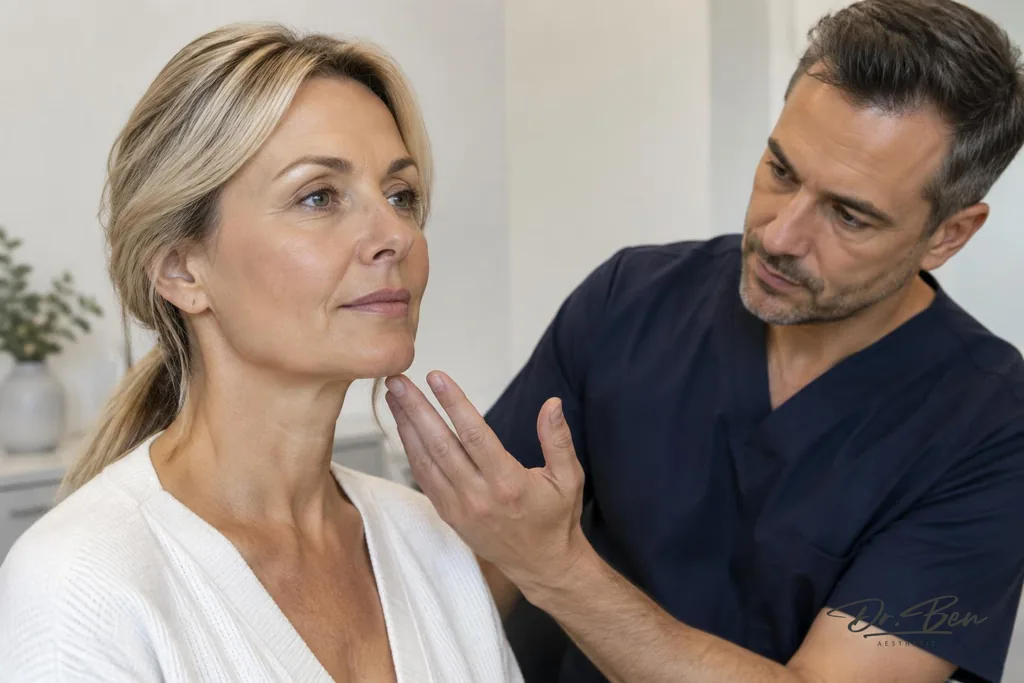
What Is Skin Laxity?
Skin firmness depends partly on collagen and elastin within the skin, as well as connective tissue, fat compartments, muscle, bone and other deeper support. With time, these structures can change at different rates. The skin may feel less elastic or sit differently over the underlying face and body.
Laxity is not the same as facial volume loss, fat repositioning, muscle movement or an individual’s normal anatomy, although these features can overlap. Cosmetic Consultation & Facial Assessment considers the face as a whole before any option is discussed.
Where Is Skin Laxity Commonly Noticed?
Lower Face and Jawline
Reduced definition along the lower face, soft-tissue descent or early jowling may be described as laxity. These changes do not automatically require treatment, and the visible concern may involve skin, fat, volume and underlying structure.
Cheeks and Midface
Changes through the cheeks can reflect both skin laxity and altered facial volume. A Facial Contouring & Volume Assessment helps distinguish these processes rather than assuming that tightening or adding volume is the correct response.
Neck and Under-Chin Area
The neck and under-chin area can be influenced by skin, superficial fat, neck muscles, chin position and inherited anatomy. Examination is needed to understand which features contribute to the concern.
Around the Eyes
Eyelid and under-eye concerns are anatomically complex. Skin quality, fat position, swelling and lid support may all matter, and specialist assessment or referral can be more appropriate for some people.
Other Areas
Reduced firmness may also be noticed on the arms, abdomen or thighs, particularly after significant weight change. The causes and reasonable options differ by area and degree of skin excess.
Why Does Skin Laxity Develop?
Natural Ageing
Collagen, elastin, fat compartments, bone and other supporting tissues change throughout adult life. This is a normal biological process, not a defect, and it varies considerably between individuals.
Sun Exposure
Accumulated ultraviolet exposure contributes to photoageing and can affect collagen, elasticity, pigmentation and texture. The amount of visible change depends on exposure history, skin characteristics and other factors.
Genetics
Inherited facial structure, tissue distribution and skin characteristics influence where and when reduced firmness becomes noticeable.
Changes in Facial Volume
Age-related or weight-related changes in fat and deeper support can alter how the skin sits. Volume change and laxity may coexist but require separate consideration.
Significant Weight Changes
Substantial weight loss can leave skin that does not fully adapt to the smaller underlying volume. The degree varies with age, genetics, rate of change and the area involved.
Lifestyle and Environmental Factors
Smoking and repeated ultraviolet exposure can accelerate visible skin ageing. General health, inflammatory skin disease and environmental exposures may also affect skin quality, but no lifestyle measure can completely prevent normal ageing.
Skin Laxity Versus Facial Volume Loss
Skin laxity and facial volume loss are distinct processes, although they often overlap. Reduced firmness relates to skin and support, while volume change may involve fat compartments, bone and soft-tissue distribution. Treating the wrong feature can produce an unhelpful or unnatural result.
A careful whole-face assessment considers skin, contour, movement, proportions and normal asymmetry. It avoids assuming that a concern labelled as ‘loose skin’ should be managed with either a tightening procedure or a volume-based intervention.
Can Skin Laxity Be Prevented?
Normal ageing cannot be stopped. Regular sun protection, not smoking, suitable skin care, stable general health and appropriate management of active inflammatory skin disease may support skin health and reduce avoidable damage.
Creams and topical products may improve dryness, surface texture or signs of photoageing, but they cannot be expected to reverse substantial loose skin or reposition deeper tissues. A Skin-Quality Consultation can help separate skin-surface goals from concerns involving deeper anatomy.
How Is Facial Skin Laxity Assessed?
Assessment begins with the change you have noticed and what, if anything, you would like to understand or improve. Dr Ben reviews skin thickness, elasticity and texture alongside the jawline, neck, facial volume, movement, proportions and underlying anatomy.
Relevant history includes weight change, sun exposure, general health, medicines, allergies, smoking, skin conditions and previous cosmetic or surgical procedures. Your priorities and expectations are discussed without presuming that intervention is necessary. Sudden, painful or medically concerning changes may require investigation or referral rather than cosmetic treatment.
What Happens During Your Skin Laxity Consultation?
1. Your Concerns and Goals
You describe the areas that concern you, when the change began and what outcome you consider realistic. There is space to discuss uncertainty or a preference for information only.
2. Medical and Previous-Procedure History
Medical conditions, medicines, allergies, pregnancy or breastfeeding where relevant, previous procedures, surgery and any earlier complications are reviewed.
3. Anatomy and Skin Assessment
The skin, facial proportions, volume, movement, jawline and neck are examined to identify the likely contributors and whether further medical assessment is needed.
4. Options, Observation or Referral
Discussion may include skin care, selected procedural options, monitoring, choosing no procedure or referral for surgical or other specialist assessment. Availability and suitability are confirmed rather than assumed.
5. Risks, Alternatives, Fees and Consent
Material risks, limitations, alternatives, likely recovery, Consultation Fees and the consent process are discussed before any decision. There is no pressure to proceed on the day or at all.
What Management Options May Be Discussed?
Medical Skin Care
Individual skin care may help dryness, texture and ultraviolet-related change. A Skin Rejuvenation assessment may help distinguish surface-quality goals from deeper laxity, but skin care does not remove significant excess skin or reliably tighten deeper facial tissues.
Collagen-Stimulating Treatments
Collagen-Stimulating Treatments use differing techniques and have different evidence, limitations and risks. Where suitable, improvement may be gradual and variable; they should not be represented as producing a substantial lift.
Skin Boosters & Bioremodelling
Skin Boosters & Bioremodelling may be discussed for selected skin-quality concerns, but they are not equivalent to surgical skin removal or a guaranteed tightening treatment. Suitability and treatment-specific risks require individual assessment.
Radiofrequency-Based Treatments
Some radiofrequency approaches aim to create controlled tissue heating. Evidence and results vary by device, settings, anatomy and operator. Risks can include pain, burns, scarring, pigment change and unintended tissue injury, and clinic availability is not assumed.
Radiofrequency Microneedling
Radiofrequency Microneedling combines needles with energy delivery and may be discussed for selected indications. Machine type, settings, skin type and anatomy affect risk, and it is not a universal treatment for laxity.
Ultrasound-Based Energy Treatments
Selected ultrasound-based energy technologies may be discussed only where genuinely available and appropriate. Possible risks include pain, burns, nerve symptoms and unintended tissue changes. These technologies are not the same as diagnostic ultrasound used when assessing previous filler concerns.
Facial Volume Assessment
Volume assessment addresses contour and support rather than directly tightening skin. Volume-based procedures carry their own limitations and risks and are not a substitute for assessment of significant skin excess.
Surgical Assessment
For selected people with significant skin excess or tissue descent, assessment by an appropriately qualified surgical specialist may be more relevant. Referral does not mean that surgery is required, and surgery has important risks and recovery considerations.
How Effective Are Non-Surgical Skin-Tightening Treatments?
Results vary with the degree and location of laxity, skin thickness, facial anatomy, technology, operator technique, healing response and follow-up. Some people may notice modest change, while others may see little useful improvement.
Non-surgical treatments are not equivalent to surgery and cannot guarantee dramatic, permanent or precisely predictable tightening. Published evidence for one technology or setting may not apply to every device, person or treatment area.
Potential Risks of Skin-Laxity Treatments
Risks depend on the treatment and area. They can include pain, redness, bruising, swelling, burns, blistering, inflammation, infection, post-inflammatory hyperpigmentation or hypopigmentation, scarring, prolonged numbness, contour change, tissue damage and an unsatisfactory result.
Some energy-based modalities can cause nerve injury or unintended fat loss. Specific injectable or procedural treatments have further individual risks. No skin-laxity treatment is risk-free, and a favourable outcome cannot be promised.
Skin Laxity and Different Skin Types
Skin tone, thickness, tendency to pigment after inflammation, scarring history and the proposed technology are assessed individually. Some procedures require particular caution or adjusted settings in skin with a higher risk of pigment change.
A darker skin tone does not automatically make every treatment unsuitable. The relevant question is whether a specific procedure can be used safely and reasonably for that person, by an appropriately trained practitioner, with informed consent and follow-up.
When Might Surgical Assessment Be More Appropriate?
Specialist surgical assessment may be more appropriate when there is marked skin excess or tissue descent, when a person’s goals are unlikely to be met by a non-surgical option, or when previous procedures have produced complex concerns.
An appropriately qualified specialist can explain whether surgery is reasonable, its material risks, expected recovery and alternatives. Seeking an opinion creates no obligation to proceed, and choosing no treatment remains valid.
Realistic Expectations and Natural Ageing
Normal ageing cannot be reversed, and every face continues to change over time. A reasonable discussion focuses on the concern you identify, the limits of available options and whether the likely benefit justifies the burden and risk.
There is no single correct facial shape, degree of firmness or age at which treatment is needed. Choosing not to treat is appropriate. Advice should remain clinically neutral rather than promoting an artificial beauty standard.
When Should Skin Changes Be Medically Investigated?
Seek medical assessment for sudden or one-sided swelling, a new lump, persistent pain or inflammation, neurological symptoms, or a concern following a previous cosmetic procedure. These features should not be assumed to represent ordinary laxity.
Sudden facial weakness or drooping—especially with difficulty speaking, arm or leg weakness, severe headache, dizziness or confusion—may be an emergency. Call 000 in Australia without delay.
Skin Laxity & Facial Firmness Consultations in Melbourne
Dr Ben consults at Capstone Medical Centre Southbank, 216 City Road, Southbank VIC 3006, and at Cosmetic Avenue Malvern, 1308 Malvern Road, Malvern VIC 3144. These are independent clinical locations.
Appointment availability and procedures offered can differ between locations. Please confirm current availability and where any proposed procedure is performed before booking.
Arrange a Skin Laxity Consultation
A doctor-led consultation can review reduced firmness, jawline change or other age-related concerns in the context of your skin, anatomy, health and previous procedures. It can clarify whether skin care, observation, a selected procedure or referral is reasonable.
Information on this page is general and does not diagnose the cause of a change or recommend a treatment. Decisions are individual, alternatives and material risks should be discussed, and you may choose not to proceed.
Common questions
- What causes facial skin laxity?
- Facial skin laxity can reflect normal age-related changes in collagen and elastin, ultraviolet exposure, genetics, weight change and changes in deeper fat, muscle and bone support. Several factors often overlap.
- Is skin laxity the same as facial volume loss?
- No. Laxity describes reduced firmness or support, while volume loss relates to changes in fat compartments, bone and other deeper tissues. They can occur together, so assessment should distinguish their relative contribution.
- Can skin laxity be reversed naturally?
- Normal ageing cannot be reversed. Sun protection, not smoking and suitable skin care can support skin health, but they cannot reliably restore substantially loose skin to its earlier state.
- Can skin-care products tighten loose skin?
- Products may improve hydration, texture and some signs of photoageing. They are not expected to remove significant excess skin or reposition deeper facial tissues.
- Do collagen-stimulating treatments improve skin firmness?
- Some treatments may support gradual changes in selected people, but techniques, evidence and risks differ. Any improvement can be modest or variable, and a substantial lift cannot be guaranteed.
- Is radiofrequency treatment suitable for everyone?
- No. Suitability depends on the concern, anatomy, skin type, medical history, device, settings and operator. Risks can include burns, pigment change, scarring, nerve symptoms and unintended tissue effects.
- Can ultrasound-based treatments improve skin laxity?
- Certain energy-based ultrasound technologies may be considered for selected people, but results and evidence vary. They carry risks and are different from diagnostic ultrasound used to assess previous filler.
- Can non-surgical treatments replace a facelift?
- Non-surgical treatments are not equivalent to surgery and should not be expected to produce the same degree of change. When skin excess or tissue descent is marked, specialist surgical assessment may be more appropriate.
- How many skin-tightening treatments will I need?
- There is no standard number. It depends on the concern, technology, response, risks and whether further treatment remains reasonable after review. A course should not be promised before assessment.
- Are skin-tightening treatments painful?
- Discomfort varies by procedure, settings, area and individual. Some treatments can be painful during or after treatment, and pain-control options and their limitations should be discussed beforehand.
- Can skin laxity return after treatment?
- Ageing and tissue change continue after any treatment. Even when improvement occurs, it may change over time, and no result should be described as permanent or guaranteed.
- Do I need a procedure for loose or ageing skin?
- No. Skin laxity is often a normal age-related change. You may seek information, monitor the concern, use supportive skin care or choose no treatment. A consultation does not oblige you to proceed.
Next step
Arrange a consultation
Assessment in person is the only way to work out what is causing a skin concern and what can reasonably be done about it. Fees are explained before anything is arranged.
Medical disclaimer
This page is general information only and is not a diagnosis, a treatment recommendation, or a substitute for individual medical advice. Conditions that look similar can have different causes, and what is suitable for one person may not be suitable for another. If you are unwell, in significant pain, or worried about a rapidly changing symptom, seek medical care promptly. In an emergency call 000.
- Written for patients by
- Dr Benyamin Mansoori, cosmetic physician & skin cancer doctor
- Medically reviewed by
- Dr Benyamin Mansoori (MD, FRACGP, FACCSM), AHPRA MED0002097300
- Last medically reviewed