Skin Concerns
Facial Redness & Visible Blood Vessels Assessment in Melbourne
Dr Benyamin Mansoori provides doctor-led clinical assessment of facial redness, flushing and visible superficial vessels in Southbank and Malvern, Melbourne. Recurrent redness may be associated with rosacea, sunlight, inflammation, sensitivity or skin-barrier dysfunction, but different causes can look similar.
The first step is an individual diagnosis and an understanding of your symptoms, medical history and priorities. Medical care, skin care, observation or referral may be more appropriate than a cosmetic procedure. No treatment is obligatory and outcomes cannot be guaranteed.
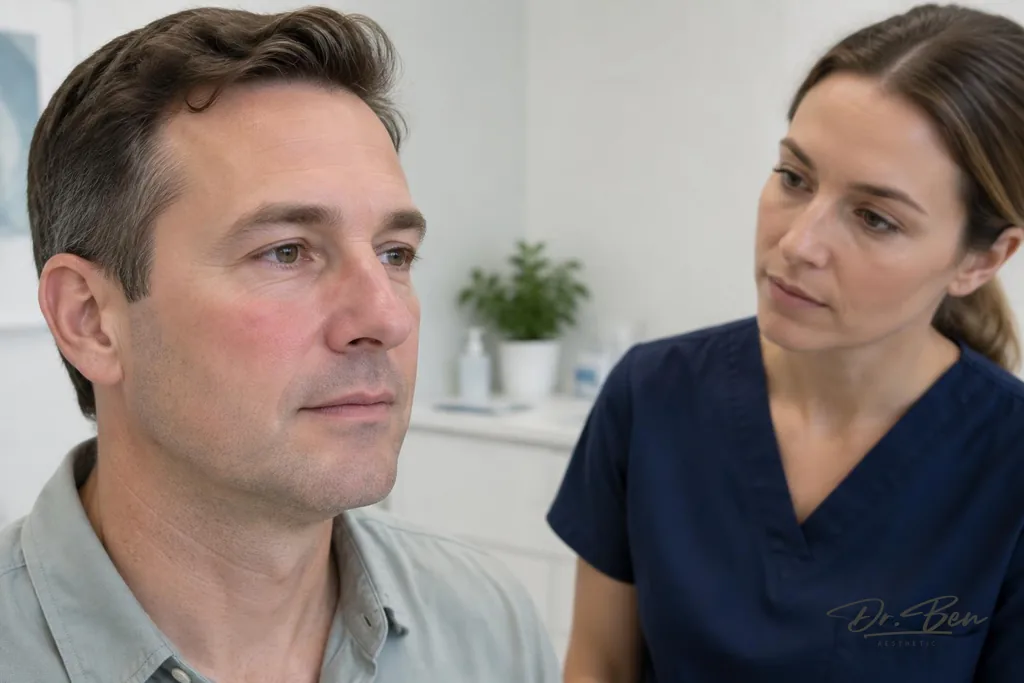
What Causes Facial Redness?
Facial redness can reflect increased blood flow through superficial vessels, inflammation within the skin, or a combination of both. Temporary flushing may settle after a trigger passes, whereas persistent inflammatory redness can remain between episodes. These patterns are not interchangeable and do not necessarily need the same care.
Possible contributors include rosacea, sun exposure, naturally visible vessels, dermatitis or eczema, skin sensitivity and disruption of the skin barrier. Irritating products, medications and environmental conditions can also play a part. Less commonly, flushing or redness may be associated with another medical condition. The location, duration, symptoms and medical history guide the assessment rather than appearance alone.
Understanding Different Types of Facial Redness
Temporary Facial Flushing
Flushing is an episode of warmth and increased facial colour that may come and go. Exercise, heat, emotion, alcohol or spicy foods can be triggers, but the pattern differs between people. Not all flushing is rosacea. Frequent, severe or unexplained episodes, particularly with other symptoms, deserve medical assessment rather than an assumption that they are cosmetic.
Persistent Facial Redness
Redness that remains on the central face may occur with rosacea, but dermatitis and other inflammatory conditions can look similar. Associated scaling, spots, itch or burning, and whether symptoms fluctuate, help distinguish the possibilities. A diagnosis is needed before selecting a redness-directed procedure.
Visible Facial Capillaries
Telangiectasia describes small, visible superficial blood vessels, often appearing as fine red or purple lines around the nose and cheeks. They are sometimes called “broken capillaries”, although they are not necessarily literally broken. Sun exposure, rosacea, ageing and individual skin characteristics can make these vessels more noticeable.
Redness Associated with Sensitive Skin
Stinging, burning, dryness or tightness can accompany redness when the skin barrier is irritated. Contact dermatitis may result from exposure to a product or allergen. A Skin Rash Assessment can help distinguish an inflammatory rash from vascular visibility, particularly when symptoms persist despite changes to skin care.
Redness Associated with Inflammatory Skin Conditions
Eczema, seborrhoeic dermatitis and other inflammatory skin conditions may cause facial redness with itching or scale. Treating the underlying condition is generally more important than trying to reduce its colour cosmetically. Laser treatment is not a substitute for diagnosis or medical management of an active rash.
What Is Rosacea?
Rosacea is a chronic inflammatory disorder that commonly affects the central face. It may involve flushing, persistent erythema (redness), visible vessels, papules or pustules, stinging and sensitivity. Some people also develop eye-related symptoms. Different features can occur together or change over time, and redness alone does not establish the diagnosis.
A Medical Rosacea Assessment considers the pattern of symptoms and other conditions that may resemble rosacea. The condition often follows a relapsing course, with periods of improvement and flare-ups. Management aims to control relevant features and support comfort; a permanent cure or completely redness-free skin cannot be promised.
Rosacea Versus Acne: Why the Difference Matters
Acne commonly includes blackheads and whiteheads, known as comedones, as well as inflammatory spots. Papules and pustules in rosacea usually occur without these acne comedones. However, acne and rosacea can coexist, and not every facial spot can be classified from a photograph or description.
The Acne & Acne Scarring page explains active acne, residual marks and structural scars, which are different concerns from flushing or superficial vessels. Distinguishing them matters because their care differs. Strong exfoliants or products chosen for acne can aggravate sensitive, rosacea-prone skin, so an individual assessment should guide the regimen.
What Causes Visible Blood Vessels on the Face?
Genetic and Individual Skin Characteristics
Some people naturally have more noticeable superficial vessels because of inherited characteristics, skin thickness or the way vessels are distributed. A few stable vessels may be a benign variation rather than a disease or a reason to have treatment.
Sun Exposure
Cumulative ultraviolet exposure can affect the skin and supporting tissues, making superficial vessels more apparent. Sun protection supports skin health, although it does not necessarily reverse vessels already visible.
Rosacea
Repeated flushing and ongoing inflammation associated with rosacea can accompany visible facial vessels. A person may have persistent redness, individual vessels or both; management should address the features actually present.
Age-Related Changes
Changes in skin thickness and supporting structures with age may increase vascular visibility. These changes are variable and do not by themselves indicate a need for a procedure.
Other Skin or Medical Conditions
Other inflammatory conditions and relevant topical medication use, including prolonged or inappropriate use of some steroid preparations, can contribute to redness or vascular changes. Do not stop prescribed medication without advice. New, unusual, rapidly changing or symptomatic findings should be assessed rather than assumed to be harmless capillaries.
When Is Facial Redness a Medical Rather Than Cosmetic Concern?
Persistent burning, itching, pain or scaling, recurrent swelling, a widespread rash, a possible reaction to a new medication, or suspected infection warrant medical review. Eye irritation and vision symptoms also need attention. A non-healing or changing lesion may require a Mole & Lesion Assessment to consider skin cancer or another diagnosis before any cosmetic treatment.
Rapidly spreading, painful redness with fever or feeling unwell requires urgent medical care. Severe eye pain, light sensitivity (photophobia), or any new visual change requires urgent eye or emergency assessment rather than waiting for a cosmetic appointment. Facial swelling with breathing difficulty or other signs of a severe allergic reaction is an emergency: call 000.
How Are Facial Redness and Visible Vessels Assessed?
Assessment begins with when symptoms started, whether redness persists or occurs in flushing episodes, and where it appears. Dr Benyamin Mansoori may ask about itching, stinging, burning, swelling, visible vessel networks and any associated eye symptoms. Heat, sun exposure, exercise, emotional triggers and other circumstances can help clarify the pattern.
Your skin-care routine, medications, allergies, previous cosmetic treatments and response to earlier management are relevant. Clinical examination considers both the skin and the distribution of superficial vessels. Investigations are selective rather than automatic, and referral may be appropriate when the presentation is atypical, the diagnosis is uncertain, or another medical or eye condition is suspected.
What Happens During Your Consultation?
- Symptoms and goals: discuss what you have noticed, how it affects comfort or appearance, and what you hope to understand or improve.
- Medical, trigger and product history: review relevant conditions, medications, allergies, flushing triggers, sun exposure, skin care and previous treatments.
- Clinical examination: assess the distribution of redness, superficial vessels, inflammatory changes and symptoms that may point to another diagnosis.
- Individual management: consider barrier support, medical care, monitoring, referral, sometimes a suitable procedure, or no treatment at all.
- Informed decision-making: discuss expected benefits, material risks, limitations, costs and informed consent before deciding whether to proceed, without pressure.
Consultation Fees are available separately so you can understand the assessment cost. Any proposed procedure and its individual fees are explained before you decide. Assessment does not commit you to treatment, and a procedure at the first visit is not assumed.
What Management Options May Be Discussed?
Skin-Care and Barrier Support
A gentle cleanser, a suitable moisturiser and regular photoprotection may help support an irritated skin barrier. Avoiding over-exfoliation and unnecessarily complex or irritating regimens can be useful. Products should be selected for your symptoms and tolerance rather than assuming every product labelled for redness will suit you.
A Skin-Quality Consultation addresses broader concerns such as texture and skin quality. It does not replace diagnosis or medical care when redness reflects an inflammatory condition.
Identifying and Managing Triggers
Triggers for flushing or rosacea are individual. Noticing a repeatable pattern can be helpful, but there is no need to impose broad dietary or lifestyle restrictions without a clear reason. Practical changes should be proportionate and should not replace medical review when symptoms are persistent or severe.
Medical Management of Rosacea
Medical care is tailored to the features present, which may include inflammatory spots, discomfort or persistent redness. Prescription options, where appropriate, are discussed privately following assessment; this page does not promote or recommend a particular prescription treatment. Follow-up can help review tolerance, response and changing symptoms.
Assessment of Visible Blood Vessels
Many superficial vessels are benign and can be left alone. Clinical diagnosis comes first, particularly for a new or unusual finding. A selected vascular procedure may be discussed only if the finding, skin characteristics and medical history make it a reasonable option.
Laser and Light-Based Treatments
Selected vascular lasers and light-based devices act on blood vessels in different ways, and their evidence, practical limitations and risks vary. Not all redness is a vascular target and not all redness responds. The Redness & Vascular Concerns page provides further information about skin and laser assessment. Availability of a particular device or procedure must be confirmed with the consulting clinic; it should not be assumed at either location.
Specialist Referral
Dermatology or another specialist opinion may be appropriate for severe, atypical or uncertain presentations, or when initial care is not helping. Ocular symptoms may require eye assessment. Referral is a valid outcome of consultation, not an indication that a cosmetic procedure must follow.
Can Laser Treatment Reduce Visible Facial Vessels?
Selected vascular lasers or light-based devices may improve some superficial telangiectasia. Suitability depends on the vessel type, depth and distribution, skin tone, underlying diagnosis and individual risk factors. Redness from dermatitis, irritation or other causes should not automatically be treated as a vascular problem.
Response varies. Some vessels may remain, new vessels may develop, and a staged course is sometimes discussed rather than a single session. Treatment cannot guarantee removal of all redness or vessels. The likely benefit, alternatives and limitations need to be considered alongside procedural risks before deciding whether to proceed.
Potential Risks of Vascular and Redness Treatments
Risks depend on the treatment, device, settings, treatment area, skin type and medical circumstances. Potential effects include discomfort or pain, temporary redness and swelling, burns, blistering, changes in pigmentation (darker or lighter skin), infection and scarring. Persistent sensitivity, recurrent redness and an unsatisfactory result are also possible.
Laser or light exposure can pose an eye-injury risk if appropriate protection and precautions are not used. The risks and required protection are specific to the procedure. No procedure is entirely risk-free, and individual counselling is needed rather than assuming a treatment described as non-surgical is harmless.
Facial Redness and Different Skin Tones
Inflammation is not always visibly pink or bright red. In some skin tones it may be subtler, appear darker or violaceous, or be recognised through warmth, swelling, stinging and other symptoms. Assessment should not depend on pinkness alone or overlook inflammation because colour change is less obvious.
Pigmentary risks from laser or light-based treatment need individual assessment, including the device being considered, skin characteristics, sun exposure and history of pigment changes. A treatment that suits one person may not suit another. Deferring a procedure or choosing medical care may be the safer option.
Can Facial Redness Return After Treatment?
Yes. Rosacea is chronic and can fluctuate even after a period of improvement. Telangiectasia may recur or new vessels may appear over time. Sun exposure, ongoing inflammation and individual tendencies can influence this course, but recurrence cannot always be predicted or prevented.
Follow-up may focus on skin comfort, ongoing medical care, barrier support and reviewing triggers. Further procedures are not automatically necessary. No intervention should be presented as a permanent cure for all facial redness.
Realistic Expectations and Skin Health
Physiological flushing and some visible capillaries can be normal, benign features. The aim is to identify whether a medical condition is present, understand what matters to you, and agree on realistic goals. Completely uniform skin colour is not a necessary or always achievable measure of skin health.
Observation, simple skin care, medical management or referral may be more appropriate than a procedure. You can choose not to proceed with cosmetic intervention. Where a procedure is reasonable, its expected benefit and limitations should be clear, without guarantees or pressure.
Facial Redness & Visible Vessels Consultations in Melbourne
Dr Benyamin Mansoori consults at Capstone Medical Centre Southbank, 216 City Road, Southbank VIC 3006, and Cosmetic Avenue Malvern, 1308 Malvern Road, Malvern VIC 3144. These are independent consulting sites where he sees patients.
Confirm appointment availability and the services offered with the relevant clinic. A consultation at a location does not mean that every device, vascular procedure or treatment discussed on this website is offered there.
Arrange a Facial Redness Assessment
A doctor-led assessment can help clarify the cause of facial redness or visible vessels and whether skin care, medical management, monitoring, a selected vascular procedure or specialist referral is appropriate. The starting point is diagnosis and your individual circumstances, not an obligation to have cosmetic treatment.
This information is general education only, not a diagnosis, treatment recommendation or substitute for individual medical advice. Seek prompt medical care for concerning symptoms. Rapidly spreading painful redness with fever or illness, severe eye pain, light sensitivity or visual changes needs urgent assessment rather than a routine cosmetic booking. In an emergency, call 000.
Common questions
- What causes persistent facial redness?
- Possible causes include rosacea, dermatitis, skin-barrier irritation, sun-related vascular changes and other skin or medical conditions. The distribution, duration and associated symptoms help guide assessment; persistent redness should not be diagnosed from its colour alone.
- Is facial redness always caused by rosacea?
- No. Temporary flushing, eczema, contact dermatitis, other inflammatory conditions and naturally visible vessels can also cause facial redness. Clinical assessment helps distinguish these causes, which may need different care.
- What are visible facial capillaries?
- They are small superficial blood vessels that are visible through the skin, often called telangiectasia. They may appear as fine red or purple lines around the nose or cheeks. The term “broken capillaries” does not mean they are necessarily literally broken.
- Are visible blood vessels dangerous?
- Many stable superficial facial vessels are benign and do not need treatment. However, new, unusual, changing or symptomatic findings should be medically assessed, especially if associated with a non-healing lesion, bleeding or other concerning changes.
- Can rosacea be permanently cured?
- A permanent cure cannot be promised. Rosacea is usually a chronic, relapsing condition. Individual care can help manage its features and comfort, but flare-ups or ongoing symptoms may still occur.
- Can facial flushing be caused by stress or heat?
- Yes. Emotion, stress, heat and exercise can cause temporary flushing, as can other individual triggers. This does not always indicate rosacea. Frequent, severe or unexplained flushing, particularly with other symptoms, warrants medical review.
- Can laser treatment remove facial redness?
- Selected vascular lasers or light-based treatments may improve some superficial vessels and suitable vascular redness. They do not address every cause of redness, and response varies. Complete removal is not guaranteed; inflammatory conditions may need medical care instead.
- How many treatments are needed for visible facial vessels?
- There is no fixed number suitable for everyone. The vessel pattern, skin characteristics, device, response and risks influence planning. Staged sessions may sometimes be discussed, while some vessels persist or recur. A personal plan is considered after assessment.
- Can skin-care products make redness worse?
- Yes. Irritating products, over-exfoliation or a contact reaction can worsen redness, stinging and dryness. Gentle barrier-supportive care may help, but persistent symptoms need assessment rather than repeatedly adding products. Ask for advice before changing prescribed skin medication.
- Can rosacea affect the eyes?
- Yes. Ocular rosacea may cause irritation, dryness, gritty sensations or eyelid inflammation. Eye symptoms need assessment rather than being assumed to be harmless. Severe eye pain, light sensitivity or any new visual change requires urgent eye or emergency care.
- Are vascular treatments suitable for darker skin tones?
- Sometimes, but suitability must be assessed individually. Skin characteristics, device choice, settings and risk of darker or lighter pigmentation all matter. No blanket assurance of safety applies to every skin tone or procedure; another approach or no procedure may be recommended.
- Do I need a cosmetic procedure for facial redness?
- No. Assessment may lead to barrier support, medical care, monitoring, referral or no treatment. A cosmetic procedure is optional and is discussed only when appropriate, with its benefits, material risks, limitations and costs explained before informed consent.
Next step
Arrange a consultation
Assessment in person is the only way to work out what is causing a skin concern and what can reasonably be done about it. Fees are explained before anything is arranged.
Medical disclaimer
This page is general information only and is not a diagnosis, a treatment recommendation, or a substitute for individual medical advice. Conditions that look similar can have different causes, and what is suitable for one person may not be suitable for another. If you are unwell, in significant pain, or worried about a rapidly changing symptom, seek medical care promptly. In an emergency call 000.
- Written for patients by
- Dr Benyamin Mansoori, cosmetic physician & skin cancer doctor
- Medically reviewed by
- Dr Benyamin Mansoori (MD, FRACGP, FACCSM), AHPRA MED0002097300
- Last medically reviewed